From coastlines to consciousness, discovering nature’s universal strategy for solving complex problems.
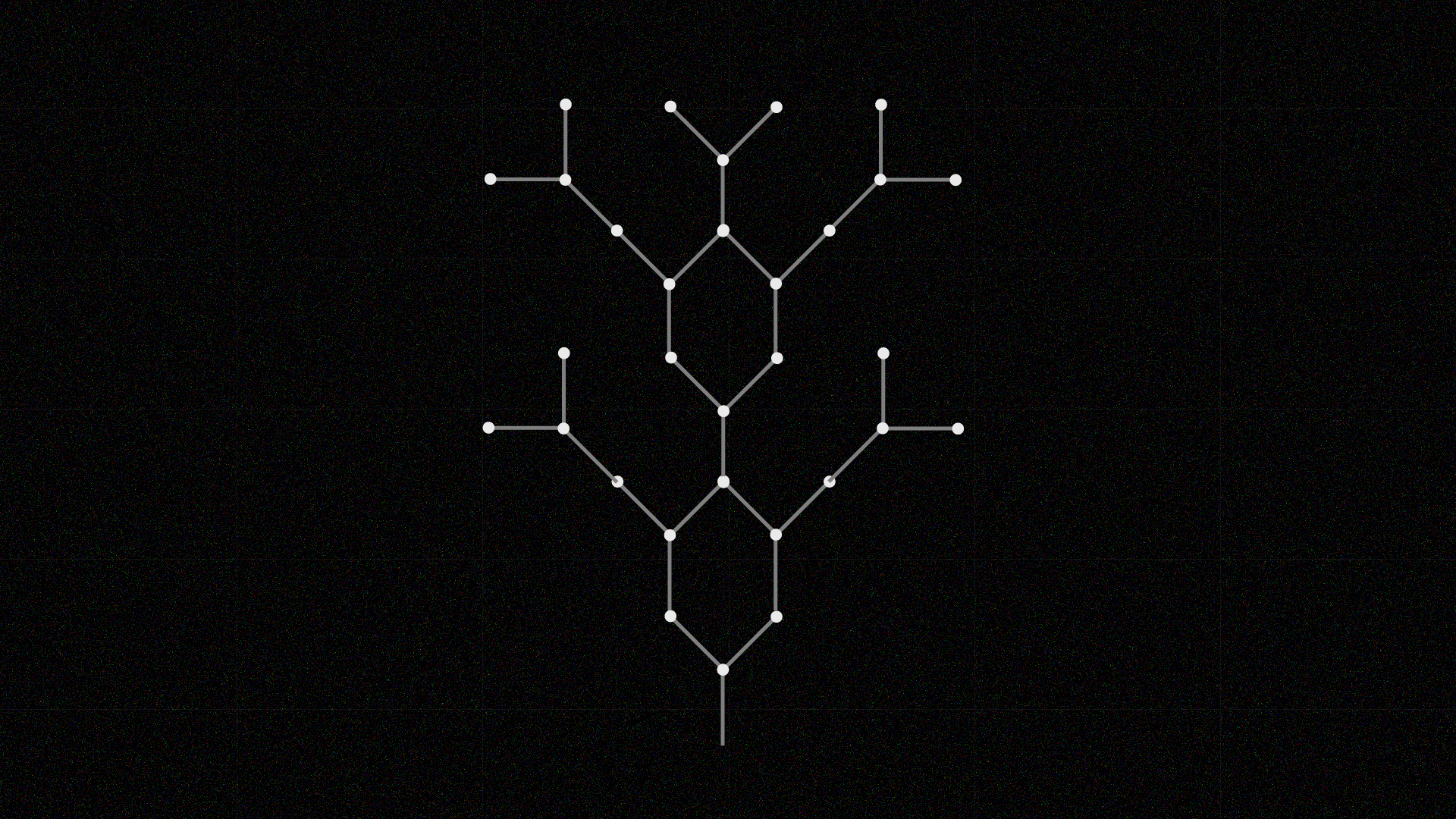
Try zooming into a coastline on Google Earth. You’ll notice something remarkable: those jagged edges where land meets water look essentially the same whether you’re viewing from space or from just above the beach. Nature repeats this pattern at every scale, creating what mathematicians call a fractal. Once you understand this pattern, you begin to see it everywhere in our world.
Ancient Indian philosophers grasped this fundamental truth long before we had the mathematics to describe it. They spoke of Indra’s Net – a cosmic web stretching to infinity, with a jewel at each intersection reflecting every other jewel. This profound metaphor perfectly captures what modern science now understands about the interconnected, self-similar patterns that shape our universe.
Nature employs this recursive pattern because it works with remarkable efficiency. Consider your lungs – they’re not simple air sacs, but rather an intricate network of branching airways, each branch a smaller version of the whole. This elegant design allows you to pack a tennis court’s worth of breathing surface into your chest, maximizing efficiency in a confined space. This same principle appears throughout the natural world, from the branching patterns of trees maximizing their exposure to sunlight to river deltas distributing water across vast landscapes.
At its core, the fractal pattern represents nature’s elegant solution to complex optimization problems. Consider how this plays out across different scales of existence. In biological evolution, we see this optimization strategy at work in the nautilus shell, which has maintained the same spiral mathematics for 500 million years – predating even the existence of trees on Earth. This isn’t mere persistence; it’s evidence of nature discovering a perfect solution and preserving it. The same optimization appears in the pattern of extinction events throughout Earth’s history, which follow fractal distributions just like earthquakes – nature’s way of maintaining balance through periodic resets at various scales.
This optimization strategy extends beyond the biological realm into human systems. Financial markets, for instance, must solve the complex problem of price discovery and resource allocation across vast networks of human decision-makers. The solution? The same fractal pattern emerges. Look at any stock chart across timeframes – daily, monthly, yearly – and you’ll see similar patterns repeating. This self-similarity isn’t coincidence; it’s the market’s way of processing information and allocating resources efficiently across different scales of time and value.
When humans build large-scale networks, we often unconsciously arrive at these same optimized patterns. The internet’s architecture, for example, solved its scaling challenges by adopting a fractal structure, with major hubs connecting to progressively smaller nodes in a self-similar pattern. Similarly, cities that grow organically over time, like London or Tokyo, develop fractal street layouts that optimize traffic flow and human interaction. In both cases, the fractal pattern emerges as the most efficient solution to complex distribution problems, whether distributing data packets or human activity through space.
Our relationship with these patterns runs deeper than mere observation. Researchers have discovered that our brains respond powerfully to fractal patterns in nature. When we observe these self-similar structures – whether in the canopy of a forest or the delicate unfurling of a fern – our neural activity shifts in ways that reduce stress and enhance cognitive function. It’s as if our minds recognize something fundamentally familiar in these patterns, something that speaks to our deep connection with the natural world.
We are, in the most profound sense, the fractal flowering of a cosmos exploring its own possibilities through the iterative patterning of matter, energy, and information. Each human thought, each technological innovation, each social structure we create is another branch in this cosmic flowering, another iteration in the universe’s grand experiment of self-discovery. Our consciousness itself might be viewed as the universe’s way of generating ever more complex and beautiful fractal patterns, each insight and creation adding new dimensions to the cosmic dance.
Next time you’re contemplating the complexity of our world, observe a tree’s branching against the sky, or the delicate veins of a leaf, or the spiral of a fern catching the morning light. You’re witnessing the same mathematical principles that shape galaxies and markets, cities and civilizations. Nature has been displaying this universal language all along, inviting us to understand its profound simplicity and endless creativity.
 Dhruv Blues
Leave a comment